 Reader Picks
A Hundred Days to Decide About a Bottle That Empties in Forty-FiveReal Mushrooms prints an exact amount beside every line on this panel, which almost nothing else on this shelf does. One number is still missing, and the same company prints it on another label.
Lion's Mane FOCUS is ninety capsules from a Calgary company that ships from Nevada: two a day, three ingredients, and a number beside each one. I read the seller's promise page against its return page, weighed each of the three lines against the trial it came from, and went looking for the one figure this panel leaves out.

This is a paid advertisement. Sponsored by Real Mushrooms Inc.

Nathaniel Crowe is the pen name of this desk.
Everything on this page about the bottle comes from the seller's own product page, its label photographs, its promise page and its return page, all read on September 20, 2026.
The four customer reviews quoted lower down are real and carry the seller's purchase mark; their portraits are illustrations, not photographs of those people.
I keep a paper calendar on the kitchen wall, the kind the hardware store still gives away in December.
Everything I try gets a date on it, and that habit is the reason I noticed the first odd thing about this bottle.
The seller offers a hundred days to decide whether the product is right for you.
The bottle holds forty-five days of capsules.
A hundred days to decide. Forty-five days of bottle.
That gap is not a sleight of hand, and I want to say so plainly before anyone reads a scandal into it.
It is, however, the most interesting thing on the page, because a promise that outlives the product by fifty-five days is either unusually generous or unusually narrow, and the only way to find out is to read the small print.
So I read it, and then I read the panel.
Lion's Mane FOCUS is a bottle of ninety capsules made by Real Mushrooms, a company registered in Calgary, Alberta, that ships orders within the United States out of a warehouse in Sparks, Nevada.
Two capsules a day, with or without food.
Three ingredients, and a number printed beside every one of them.
That last part is rarer than it sounds.
Most of what arrives at this desk prints a blend weight and a list of names, and leaves you to guess how the weight is divided.
This panel does not make you guess. It tells you 500 milligrams of one thing, 100 of another and 200 of a third, and then it leaves out a fourth number that the same company prints on a different label.
Here is the order I read it in.
The calendar first, then the panel, then each of the three lines against the trial it came from, then the number that isn't there, then the people who wrote in.
One more thing before the first item, because most of you arrived here from one of our own advertisements.
Those advertisements talk about a boxed cereal, three drinks, three foods and a handful of words a man is supposed to be able to say.
None of that is in this bottle, and I am not going to pretend otherwise.
It has its own item on this page, the eighth, with the studies beside it, and the honest version of every headline we run is in the guide linked at the foot.
Item one · The calendarA Hundred Days to Decide, One Opened Bottle per Customer, and a Second Page That Says Thirty
Start where I started, because this is the part that decides whether anything else matters.
The seller keeps a page of its own about what it calls a hundred-day satisfaction promise.
The wording is warm and short: on every product it makes, if the product isn't the right fit, it will help you find one that is, or make it right with a replacement or a full refund.
Read the conditions and the shape appears.
The promise covers one opened product per customer, and it applies only to purchases made on the seller's own site.
That is not a small footnote.
Buy the same bottle from a large online marketplace and the promise does not travel with it.

Then there is the second page, the one headed returns, and it was clearly written by a different hand.
It speaks of a thirty-day satisfaction promise, and of returns of unopened product only.
Unopened, with a prepaid label, within thirty days of shipment.
Between thirty-one and sixty days, you pay the postage yourself, and after sixty days the page says no.
So the same seller has one page that covers an opened bottle for a hundred days and another that asks for an unopened bottle inside thirty.
Both pages are on the same site, and neither mentions the other.
I am not going to tell you which one governs, because I don't know and the pages don't say.
What I will tell you is what to do about it, and it costs nothing.
- Before you order, send the seller one email and ask which page applies to an opened bottle bought directly from them.
- Keep the reply. A one-line answer in writing is worth more than either page.
- Order from the seller's own site if you want the hundred days to be even arguable. Buying elsewhere puts you outside it by the promise page's own wording.
- Write the delivery date on the bottle with a marker. A hundred days is a long time to trust your memory about a date.
The seller publishes a phone number that takes calls and texts, and an email address.
For a question this specific, I would use the email, because you want the answer in a form you can keep.
A hundred days on one page, thirty and unopened on another, and one opened bottle per customer either way. Ask first, in writing, and buy from the seller's own site.
Item two · The panelThree Lines, Three Numbers, and Why a Number Beside Every Name Is Worth Noticing
Now the label.
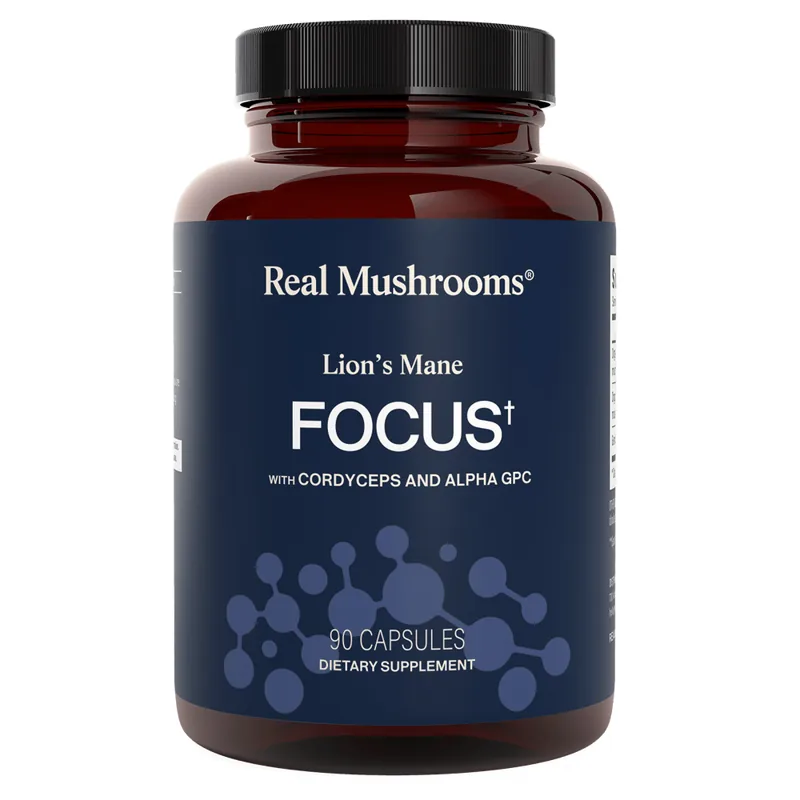
An amber bottle with a black cap, ninety vegetable capsules inside.
The serving is two capsules, so a bottle is forty-five servings, which is forty-five mornings.
The panel lists three active lines and gives each one a weight.
- Organic lion's mane fruiting-body extract, 500 milligrams per two capsules.
- Organic cordyceps fruiting-body extract, 100 milligrams.
- A branded Alpha GPC, a choline compound, 200 milligrams.
Underneath, the ordinary business of a capsule: the vegetable capsule itself, silicon dioxide, stearic acid and a little cellulose as a flow agent.
Nothing there is an active ingredient, and nothing there is hiding.
Read that panel next to almost any other bottle on the same shelf and the difference is immediate.
The common arrangement is a single blend weight, a row of eight or ten names beneath it, and no way at all to know how the weight is shared out.
When a maker prints a number beside each name, it is telling you something it cannot take back later.
It is also, incidentally, making it possible for a page like this one to be written.
The label adds four short lines about how the powder was made.
Organic mushrooms certified by the United States Department of Agriculture; no added starch, no fillers, no grain left over from growing the mycelium; gluten-free, non-GMO and vegan; and third-party laboratory testing for quality.
Those are claims about material, not about you.
I have no way to audit a laboratory from a kitchen table, but I can tell you that "no grain, no starch, no fillers" is the single most meaningful line on any mushroom label, because a great deal of what is sold as mushroom extract is mostly the grain it was grown on.

Three lines, three numbers, and a short list of what was kept out. A legible panel, and legible is not the same as effective.
Item three · The mushroomHalf a Gram of Lion's Mane a Day, and the 3.2 Grams a Day of Its Best-Known Trial
The first line, and the one the bottle is named after.

Lion's mane is an edible mushroom with long white spines that hangs off old beech and oak trees.
People cook it and eat it; the texture gets compared to crab.
The trial everyone cites gave thirty-one healthy adults over fifty a fruiting-body preparation at 3.2 grams a day for twelve weeks, and their scores on a standard mental-status test came out higher than the placebo group's. [1]
A test of visual retention in the same trial did not move at all. [1]
Thirty-one people is a small trial, and twelve weeks is a short one.
It is still the best thing on file, and it is the number this bottle has to be measured against.
Two capsules give you 500 milligrams.
That is a little under a sixth of the 3.2 grams a day the trial used.
A second and smaller study gave forty-one adults aged eighteen to forty-five a single 1.8-gram dose and found faster performance on a colour-and-word task an hour afterwards. [2]
Twenty-eight days of the same preparation produced only a trend on how the participants rated themselves, and nothing firmer. [2]
So the two doses with a result behind them are 3.2 grams a day and 1.8 grams once.
This bottle is half a gram a day.
Half a gram a day is a real ingredient at a dose nobody has tested.
I want to be fair to the maker here, because it never claims the trial's dose.
Its own page describes the product as designed to support steady thinking as part of a daily routine, and says in plain words that it is not a shortcut or a burst of productivity.
That is a modest sentence, and modest sentences deserve credit.
It is still half a gram against three point two.
Lion's mane at 500 milligrams a day, a little under a sixth of the 3.2 grams a day of the twelve-week trial in adults over fifty. Real ingredient, honest wording, dose well short of the study.
Item four · The missing numberWhat "Verified for Active Compounds" Leaves Out, and the Label Down the Shelf That Prints It
This is the item I did not expect to write, and it is the reason this page exists.
The label carries a line in capitals about being scientifically verified for active compounds.
On a mushroom product, there is one number that line usually points at, and this panel does not print it.
The number is the beta-glucan content.
Beta-glucans are long chains of glucose that make up much of the cell wall of a mushroom, and a hot-water extract concentrates them.
Makers measure beta-glucans because it is the cheapest honest way to show that the powder in the capsule is mushroom rather than the grain it grew on.
It is a quality figure, not a promise, and no trial of beta-glucans on memory or attention in healthy adults is registered anywhere I could find.
Here is the part that made me sit up.
The same company sells plain lion's mane extract capsules, and that label prints the figure: 300 milligrams of beta-glucans in every gram of extract.
So the number exists, the company measures it, and it puts it on one label and not on the other.
A maker that prints an exact weight beside all three of its ingredients has clearly decided that customers can handle numbers, which makes the absence of this one more noticeable, not less.
I can think of ordinary reasons for it.
A three-ingredient product may run its testing differently, or the panel may simply have been laid out by someone working from a different template.
I can also think of a way to settle it, and it is the same one as before.
The seller answers email and takes calls, so ask what the beta-glucan content of the lion's mane in this particular product is, and ask for it in writing.
If the answer comes back at or near the figure on the other label, you know what you're holding.
If no answer comes back, that is also information, and it cost you one email.

A capitalised line about verified active compounds, and no beta-glucan figure beside it on this panel, although the same company prints 300 milligrams per gram on its plain lion's mane label. Ask them by email before you order.
Item five · The choline compoundTwo Hundred Milligrams of Alpha GPC, and the Eighty Milligrams of Choline Inside It
The second line, and the one most likely to be misread.
Alpha GPC is choline joined to a glycerophosphate group.
Your body makes small amounts of it, and it turns up naturally in milk and in organ meats.
The useful arithmetic is this.
The compound is roughly forty per cent choline by weight, so 200 milligrams of Alpha GPC carries about 80 milligrams of choline, and it is the choline your body is after.
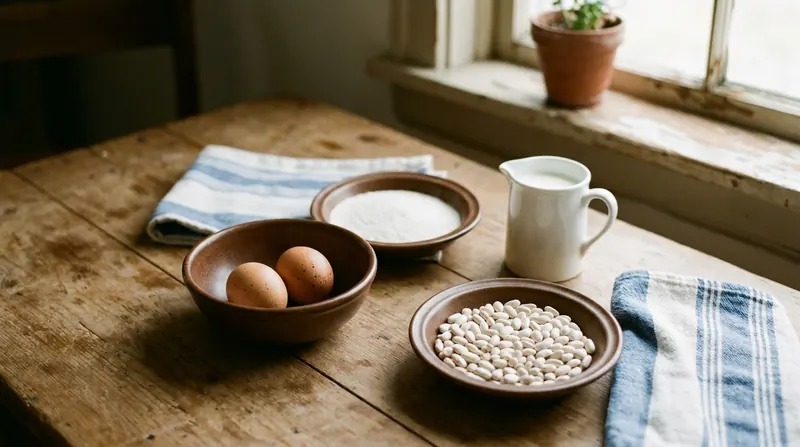
Eighty milligrams is not a large number, and the honest way to give it scale is to put it next to breakfast.
A couple of eggs carry a good deal more choline than that, and so do milk, meat and beans.
There is one large piece of research worth knowing about, and it is not a trial.
In a community cohort of 1,391 adults aged thirty-six to eighty-three, people whose diets carried more choline scored better on verbal and visual memory tests. [3]
That is an association across a town over many years, not a result for a capsule.
It says something about a pattern of eating and nothing at all about 80 milligrams in the morning.
As for Alpha GPC itself in healthy older adults, I could not register a trial to cite, so I will not pretend there is one.
The maker's own description is careful in exactly the same way: it calls the ingredient a highly bioavailable source of choline and stops there.
It is a real source of choline, at about the weight of a small piece of breakfast.
Two hundred milligrams of Alpha GPC, about 80 milligrams of choline, no trial in healthy older adults to point at, and a cohort study about diets rather than capsules. Honest wording, modest arithmetic.
Item six · The third lineOne Hundred Milligrams of Cordyceps, in a Complementary Role, With No Memory Trial Behind It
The third line, and the shortest item on this page.
Cordyceps militaris is an orange club-shaped fungus grown on grain or in liquid culture.
It stands in for the wild caterpillar fungus of the Tibetan plateau, which is far too rare to put in a capsule.
The maker says what it is doing here, and says it in its own words: cordyceps is included in a complementary role, without introducing stimulation.
That is honest, and it is also an admission.
I could not register a randomised trial of cordyceps on memory or attention in healthy adults.
The human studies I found were about exercise performance, and they were small or mixed.
One hundred milligrams is a small amount of an ingredient with nothing specific behind it for this purpose.
Read it as a third mushroom in the capsule rather than as a reason to buy the capsule.
A hundred milligrams of cordyceps, described by the maker as complementary, with no registered memory or attention trial in healthy adults. Neither a problem nor a selling point.
Item seven · The readers who wrote inTen Reviews, Nine of Them at Five Stars, and the Ten Dollars Behind the Tenth
Now the people.
The seller's own review widget carried ten reviews on the day I read it.
Nine were five stars, one was three, and all ten carried the seller's purchase mark.
Ten is a small number, and I would rather have ten I can read than a rating of four point seven assembled from somewhere I cannot see.
The seller's own page says as much in the small print: the average and the count beside the product aggregate reviews from a large marketplace as well as its own store.
So the number you see on the product page is not the number behind these ten.
Read the ten. Ignore the average.
Here are four of them, exactly as written.

I've been taking the focus mix for a few weeks and I love it! I can feel the difference in my ability to sustain focus within 30 minutes of taking it. Its become an irreplaceable staple in my daily routine. Highly recommend!

I love lions Maine Focus. I take it every morning and I'm ready for the day and stay lazer focused on what I am doing.

A fantastic product! The combination of high grade, functional mushrooms with Alpha-GPC taken a couple of hours before exercise adds a boost which I notice.

I'm only leaving this review because Real Mushrooms said they would give me a $10 credit to leave a review. I really don't know and I can't tell what is actually happening for me by taking these, but I guess psychologically I feel good about taking them. I trust the company.
Paid testimonial. The reviewer was compensated for their review. Individual results may vary.
I have kept the fourth one on purpose, and I would keep it on any page I wrote.
A man who says plainly that he was offered ten dollars to write, and that he cannot tell whether anything is happening, is the most useful review on that widget.
He also tells you something about the other nine.
If the seller offers a credit for writing a review, then some proportion of the enthusiasm above was written by people who were offered the same thing, and none of them mentioned it.
That is not fraud and I am not calling it that.
It is a thumb on the scale, and you are entitled to know the thumb is there.
Notice what none of the four describe.
Nobody reports a change in memory; they report getting started in the morning, staying on a task, and feeling better about a habit.
Ten reviews on the seller's own widget, nine at five stars, one at three that declares a ten-dollar credit, and a product-page average that quietly folds in a large marketplace. Read the ten, ignore the average.
Item eight · The bowl and the cupThe Cereal, the Three Drinks, the Three Foods and the Word Test From Our Own Advertisements
Our advertisements have been saying, in one version or another, that a boxed cereal, three drinks and three foods have something to do with memory, and that there are three words or phrases a man ought to be able to say.
You are owed the sober version in one place, so here it is.
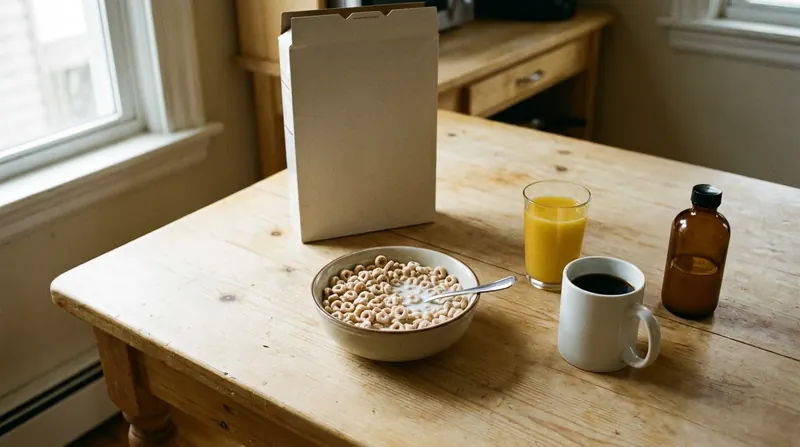
Start with the bowl.
A frosted or honey-coated cereal is mostly refined starch and added sugar, and a serving of some of them carries more sugar than a biscuit.
No cereal ages anyone faster than time does.
Nobody has measured such a thing, and that phrase was written to be clicked on.
What the research actually says is duller and more useful.
In a Brazilian cohort of 10,775 adults followed for a median of eight years, those who ate the most ultra-processed food slipped on thinking tests about a quarter faster than those who ate the least. [4]
That is an association across thousands of people, not a verdict on your breakfast.
It is also, for what it is worth, the strongest argument on this page for changing anything at all.
Now the three drinks.
The evening drink in our advertisements is alcohol, and this is where the evidence is firmest.
In 550 British civil servants followed for thirty years, higher drinking went with shrinkage of the hippocampus, the part of the brain most involved in forming memories, and with faster slippage in word fluency; light drinkers had no edge over people who did not drink at all. [5]
The word our headline got wrong is "behind": alcohol is one contributing factor among many, not the cause of anyone's memory slips.
The second drink is sugar in a glass: soda, sweetened tea, the tall flavoured coffee from the counter.
They sit on the same ultra-processed shelf as the sweet cereal, and that is the honest case against them. [4]
The third, in one of our headlines, was coffee.
That was our worst headline, and I will say so in our own paper: none of the research on this page is about plain black coffee.
Then the three foods.
Processed meat, deep-fried food, and the white-flour shelf: pastries, packaged cake, white bread.
Our advertisement says stop eating these three.
The research says something slower and less quotable.
In a three-year trial of 604 older adults, one group ate the MIND pattern, which is vegetables, berries, nuts, whole grains, beans, fish and olive oil, and the other ate its usual food with slightly fewer calories; both groups' thinking scores rose, by about the same amount. [6]
A pattern over years beat nothing, and it did not beat ordinary care with what you eat. [6]
Less sugar in the bowl and in the glass.
Less alcohol in the evening.
Keep the coffee.
Eat more like the Mediterranean shelf and less like the vending machine.
And there is one cheerful footnote for this particular bottle.
The choline the Framingham families were eating came from eggs, milk, meat and beans, which is breakfast, and it costs nothing to put more of it on the plate. [3]
Finally, the three words, or the three phrases.
There is no such list.
What the advertisement borrowed from is the short scored mental-status check that clinicians have given in person since the 1970s: the date and the place, a few words to hold and give back a minute later, a small sum, naming, copying a drawing.
It is read against your age and your schooling by someone trained to do it, and a low score is a reason for a proper look, not a verdict.
Stumbling over a word when you are tired, or being timed, means nothing on its own.
If the worry behind the click is a real one, that is fifteen minutes with your own clinician, and it is worth more than anything on this page.
And the advertisement about the things some men take every day.
That one sits closest to real research and is the one an advertisement has no business acting on.
Put everything you take into one bag, this bottle included, and take it to the pharmacist.
Ask one question: is anything here a poor choice at my age, and does anything here argue with a mushroom extract and a choline compound?
So if you clicked on the cereal, here is where it went: onto a kitchen table beside an amber bottle, where the real answer was always a plainer bowl, a fillet of fish, and the coffee you already had.
Item nine · What it isn'tSix Things Ninety Capsules Will Not Do
- They will not bring lion's mane to the dose of its trial. Five hundred milligrams a day against 3.2 grams.
- They will not tell you the beta-glucan content. The figure is on the company's other label, not this panel.
- They will not come with a trial of themselves. No study has tested this three-ingredient product.
- They will not act on any condition a clinician has named. This is a dietary supplement, and its label carries the sentence that says so.
- They will not make the hundred-day promise cover a second bottle. It is one opened product per customer, on the seller's own site.
- They will not work faster because you take four. The label says two a day, and the seller's arithmetic is built on that.
If that list irritates you, I would rather you were irritated now than on the forty-fifth morning with an empty bottle and no idea what to conclude.
Item ten · The forty-five daysIf You Do Buy It: One Bottle, the Same Breakfast, a Marked Date and a Line a Day
If you are going to try it, try it as a test with a date on it.

- Buy one bottle. Forty-five mornings is a proper test and the promise covers one opened product anyway.
- Email the seller first and ask two things: which page governs an opened bottle, and what the beta-glucan content of this product is. Keep both answers.
- Write the delivery date on the bottle with a marker, and mark the same date on whatever calendar you keep.
- Take two capsules with the same breakfast every morning. Same time, same meal, no skipping and no doubling.
- Take the bottle to the pharmacist with everything else you take, before the first capsule.
- Write one line a day somewhere. Not "sharper" or "foggier": what you were doing at ten in the morning, and how it went.
- On the forty-fifth morning, read your forty-five lines beside the forty-five before them. That is the only trial of this bottle you will ever run.
Look at that list the way I do.
Six of the seven things on it cost nothing.

This is worth a look if:
- You want a panel that prints a weight beside every name, and you will read it.
- You accept that the lion's mane sits well under the dose of its trial and want the ingredient anyway.
- You will email the seller about the two pages and keep the answer.
- You will run it as a forty-five day test with a notebook rather than as a habit you never review.
Give it a miss if:
- You were hoping for the 3.2 grams a day of the trial. This is half a gram.
- You want a study of this particular product. There isn't one, and the maker does not claim there is.
- You intend to buy it from a large marketplace and still expect the hundred days. By the promise page's own wording you would be outside it.
- You want the beta-glucan figure printed on the bottle you own. Today it is printed on a different bottle.
Item eleven · Where it's soldCalgary on the Label, Nevada on the Parcel, and a Line Above Which the Postage Stops
The bottle comes from Real Mushrooms Inc., a company whose label gives an address in Calgary, Alberta.

Orders inside the United States ship from a warehouse in Sparks, Nevada, so the parcel is a domestic one even though the company is Canadian.
The return policy prints a second Calgary address, different from the one on the label, which is another small sign that these pages were written at different times.
Postage is at no charge above the seller's order line, which sits at seventy-five dollars, and below it there is a flat charge of a few dollars.
A single bottle sits below that line, so a one-bottle test costs the bottle plus the postage, and that is the honest total.
The price on the seller's page on the day I read it was $39.95 for ninety capsules.
Over forty-five days that works out at eighty-nine cents a morning, which is a useful number to hold next to the coffee it goes with.
Check the price before you click, because it is the seller's to change and not mine to promise.
The seller publishes an email address, a telephone number that also takes texts, and a street address, which is more than a good many sellers on this desk manage.
A Canadian company, a Nevada warehouse, postage at no charge above seventy-five dollars, a bottle below that line at about eighty-nine cents a day, and a seller you can actually reach.
Every line printed on this panel, with the plain-English name, the weight, the trial behind it and who paid for that trial, is written out in the ingredient and advertising guide linked at the foot of this page.
The guide also explains the missing beta-glucan figure, and says plainly which of our own advertising headlines this bottle does and does not support.
Where to get it
Two capsules a day of organic lion's mane extract with cordyceps and a choline compound, from a Canadian mushroom company that ships from Nevada.
CHECK AVAILABILITYSold by Real Mushrooms Inc., Calgary, and shipped within the United States from Sparks, Nevada · ninety capsules, two a day, forty-five days · postage at no charge above the seller's order line; one bottle sits below it · a hundred-day satisfaction promise on one opened product per customer on the seller's promise page, and a stricter unopened-only rule on its return page: ask which applies before you buy
QuestionsWhat Readers Ask Me Before Their First Bottle
Questions readers ask
Is this medicine?
No. It is a dietary supplement: three mushroom and choline ingredients in a vegetable capsule, made by a Canadian company and shipped from Nevada.
Its label carries the standard sentence every American supplement carries, the one saying the Food and Drug Administration has not evaluated its claims.
How long does one bottle last?
Forty-five mornings. Ninety capsules, two a day by the label, which is forty-five servings.
So what is the hundred days about?
The seller keeps a page promising a hundred days to decide, covering one opened product per customer, with a replacement or a full refund, for purchases made on its own site.
Its return page says something different: unopened product only, thirty days with a prepaid label, thirty-one to sixty days at your own cost, nothing after sixty. Ask the seller in writing which one governs, and keep the answer.
How much lion's mane is in it, and is that a lot?
Five hundred milligrams a day, from the fruiting body. The twelve-week trial in adults over fifty used 3.2 grams a day, so this is a little under a sixth of it. [1]
What is the number you say is missing?
The beta-glucan content, which is how mushroom makers show that the powder is mushroom rather than the grain it grew on. This panel does not print it, although the same company prints 300 milligrams per gram of extract on its plain lion's mane label.
It is a quality figure, not a benefit: no trial of beta-glucans on memory or attention in healthy adults is on file. Ask the seller for the number by email.
What does the Alpha GPC actually give me?
Two hundred milligrams of the compound, which is about 80 milligrams of choline, since Alpha GPC is roughly forty per cent choline by weight.
Choline matters in diets over years; in a cohort of 1,391 adults, people eating more of it scored better on memory tests. [3] That is about eggs, milk, meat and beans, not about a capsule.
Does the cordyceps do anything?
Not that I can point you to. The maker calls it a complementary ingredient, and I could not register a trial of it on memory or attention in healthy adults.
Are the reviews trustworthy?
Ten on the seller's own widget, all with its purchase mark, nine at five stars and one at three. The three-star review says the seller offered a ten-dollar credit for writing it, which is worth knowing about the other nine too.
The average printed beside the product folds in reviews from a large marketplace, so it is not the average of the ten you can read.
Your advertisement was about a cereal, or three foods, or three drinks. Where is that on this page?
In the eighth item, in full, with the studies. The short version: less sugar in the bowl and the glass, less alcohol in the evening, keep your plain coffee, and eat more like the Mediterranean shelf.
None of it is in the bottle, and the ingredient and advertising guide at the foot goes through every headline we run, with a verdict on each.
Your advertisement said something about three words or three phrases. Is there a test I can take?
Not on a screen. The words come from the short mental-status check a clinician gives in person, read against your age and your schooling.
If the worry behind the click is real, ask your own clinician for the proper check. It takes about fifteen minutes.
The short versionEverything Above, in Sixty Seconds
- Ninety capsules from Real Mushrooms of Calgary, shipped from Sparks, Nevada; two a day, which is forty-five mornings; about eighty-nine cents a day at the price on the seller's page.
- The seller's promise page offers a hundred days on one opened product per customer, bought on its own site; its return page asks for unopened product inside thirty to sixty days. Ask in writing which governs.
- Lion's mane: 500 milligrams a day, a little under a sixth of the 3.2 grams a day of its twelve-week trial in adults over fifty. [1] A single 1.8-gram dose moved a task in younger adults. [2]
- Alpha GPC: 200 milligrams, about 80 milligrams of choline; the cohort research is about diets over years, not capsules. [3]
- Cordyceps: 100 milligrams, called complementary by the maker, with no registered memory or attention trial in healthy adults.
- The panel prints a weight beside every name, which is rare, and leaves out the beta-glucan figure that the same company prints on its plain lion's mane label.
- Ten reviews on the seller's widget, nine at five stars and one at three that declares a ten-dollar credit; the product-page average also counts a large marketplace.
- The cereal, three drinks, three foods and the word test from our own advertisements are in the eighth item: less sugar, less alcohol, keep the coffee, and no test on a screen. [4] [5] [6]
The last lineWhat Ninety Capsules Are Actually Worth
Here is the whole thing in one breath.
A short, legible panel from a maker that prints numbers and does not oversell them, at a dose well under the trial everybody quotes, with one figure left off that the same company prints elsewhere.
A promise of a hundred days that may or may not be the rule its own return page describes, and a seller you can email to find out.
If you are a man who likes knowing exactly what he is holding, who will run it for forty-five mornings with a notebook and a marked date, and who will send one email before ordering, that is worth one bottle.
Not because of the nine five-star reviews.
Because at the end of forty-five mornings you will know what half a gram of lion's mane and eighty milligrams of choline did for you, which is more than the label claims and more than this page can tell you.
Buy one bottle, email the seller about the two pages and the missing number, write the delivery date on the cap, take two capsules with the same breakfast, and write one line a day. Forty-five mornings in a notebook will judge this better than I can.
Check the current price and availability
Two capsules a day of organic lion's mane extract with cordyceps and a choline compound, from a Canadian mushroom company that ships from Nevada.
CHECK AVAILABILITYReal Mushrooms Inc., Calgary, Alberta · shipped within the United States from Sparks, Nevada · ninety capsules, two a day · ask the seller which of its two return pages applies to an opened bottle before you order
P.S. If you take one thing from this page, take the two dates.
Forty-five days is the bottle.
A hundred days is the promise, on one page, for one opened bottle, bought from the seller directly.
P.P.S. And if a word has been slipping away from you for a year, and it happens before the coffee as well as after it, talk to your own clinician before you buy anything at all.
Ninety capsules were never going to answer a question that a clinician answers in fifteen minutes.